
Cooling Fans in Agricultural Plant Protection UAVs: Corrosion Protection and Energy Efficiency Breakthroughs
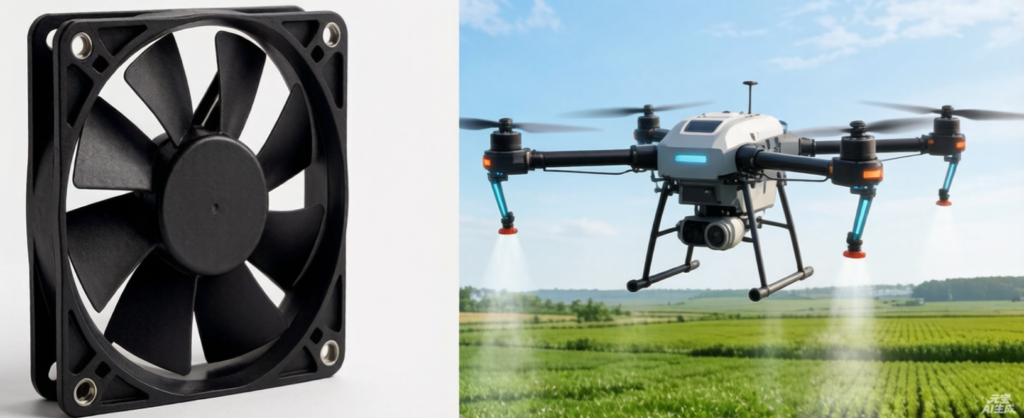
In the operational framework of agricultural plant protection UAVs, cooling fans may appear to be minor components, yet they are directly tied to the drone’s operational stability and battery endurance. Plant protection UAVs operate continuously in harsh environments characterized by pesticide droplets and dust. Under these conditions, cooling fans must not only deliver high-efficiency heat dissipation but also withstand the corrosive effects of chemical agents. Furthermore, their energy consumption directly impacts the UAV’s flight time, ultimately determining overall operational efficiency. This article explores two core aspects: protective design against pesticide corrosion and energy optimization for extended endurance, providing an in-depth analysis of the key technological breakthroughs in cooling fan design.
1. Harsh Operating Environments and Core Performance Demands
The operational scenarios for agricultural plant protection UAVs present unique challenges that translate into rigorous demands on cooling fans. Environmentally, pesticide spraying generates a massive volume of droplets containing highly corrosive chemical compounds, such as organophosphates and pyrethroids. These chemicals adhere to fan blades, motors, and housings, leading to oxidation, rusting, and eventual functional failure over time. Additionally, field dust mixes with pesticide droplets to form a viscous residue that can clog air ducts, reducing cooling efficiency and accelerating mechanical wear.
From a performance perspective, cooling fans serve as the critical cooling safeguard for the UAV’s power and flight control systems. They must achieve high-efficiency heat dissipation within highly confined installation spaces to prevent core components from overheating and shutting down. As a power-consuming component, the fan’s power draw directly affects battery life. In large-scale agricultural operations, even marginal reductions in fan power consumption can translate into significant extensions in operational flight time.
2. Core Protection Against Pesticide Corrosion: Anti-Corrosion Coating Technologies
To combat the corrosive challenges posed by pesticides and dust, anti-corrosion coating technologies have become the cornerstone of cooling fan protective design. By forming a dense, stable protective layer on critical fan components, these coatings effectively isolate the base materials from corrosive media while reducing dust adhesion, ensuring long-term operational stability. The current mainstream anti-corrosion coating technologies include:
PTFE Coating Technology: A Low-Surface-Energy Isolation Barrier Polytetrafluoroethylene (PTFE), commonly known as Teflon, is widely used in plant protection UAV cooling fans due to its exceptional chemical stability and low surface energy. The core advantage of PTFE lies in its stable molecular structure, which provides extreme resistance to organic pesticides and acidic/alkaline media. It forms a continuous protective film on fan blades and motor housings, preventing pesticide penetration into the metal substrate. Its low surface energy also makes it difficult for pesticide droplets and dust to adhere; post-operation cleaning requires only a simple air blow, preventing viscous mixtures from clogging air ducts. During application, components undergo sandblasting and degreasing pretreatment to increase surface roughness, followed by electrostatic spraying or dip coating, and finally high-temperature curing to form a uniform, dense coating (typically 20-50μm thick). A limitation of this technology is its relatively low hardness, requiring avoidance of severe impacts to prevent coating damage.
Ceramic-Based Composite Coating Technology: High-Hardness Wear and Corrosion Dual Protection For highly abrasive, dust-heavy environments, ceramic-based composite coatings stand out due to their high hardness and wear resistance. Utilizing alumina and zirconia as core components, this coating is applied via plasma spraying, where ceramic powder is melted at high temperatures and sprayed at high velocity onto the fan components. With a hardness exceeding HV800 (which can be further enhanced via nano-composite processes), it effectively resists abrasive wear from dust particles while its chemical inertness guards against pesticide corrosion. This technology is particularly suited for high-speed rotating components like fan blades, extending service life to 2-3 times that of standard coatings. However, due to the inherent brittleness of ceramic coatings, thickness must be strictly controlled (typically 50-100μm), and spraying parameters must be optimized to reduce internal stress and prevent cracking.
Zinc-Nickel Alloy Plating + Sealing Coating Technology: Deep Protection for Metal Substrates For metal structural parts like motor housings, combining zinc-nickel alloy plating with a sealing coating achieves deep-level protection. The zinc-nickel alloy layer (typically 8-15% nickel content) offers excellent corrosion resistance through electrochemical protection, delaying substrate oxidation. After passivation treatment, its salt spray corrosion resistance exceeds 1,000 hours (verified by authoritative testing to be 4.5 times that of pure zinc plating), fully meeting pesticide environment requirements. Applying an epoxy resin or polyurethane sealing coating on top further blocks moisture and pesticide droplet penetration, creating a dual “metal plating + organic coating” protection system. This process combines electrochemical and physical isolation protection with high reliability, and the uniform plating thickness (5-15μm) maintains component assembly precision.
3. Key to Extended Endurance: Design Optimization of Low-Power Fans
The endurance of plant protection UAVs directly dictates operational efficiency. While cooling fans account for approximately 5-10% of total UAV power consumption, there is significant room for optimization. Through the synergistic optimization of structural design, material upgrades, and intelligent control, low-power fans reduce energy consumption while maintaining cooling efficiency, thereby extending UAV flight time. The core design principles include:
Aerodynamic Structure Optimization: Reducing Wind Resistance and Improving Energy Efficiency The fan’s energy efficiency ratio (airflow/power consumption) is the core metric determining power draw, heavily influenced by aerodynamic design. Traditional single-curve blades generate turbulence at high speeds, increasing wind resistance and energy consumption. Low-power fans utilize fluid dynamics simulation to optimize blade airfoil curves, twist angles, and blade count. By employing a “variable cross-section airfoil” design (thicker at the root for strength, thinner at the tip to reduce drag) and adjusting twist angles to promote smooth laminar flow, turbulence is minimized. Optimizing blade count to 5-7 pieces (compared to traditional 3-4) reduces rotational inertia while maintaining airflow. These optimizations can improve the energy efficiency ratio by 20-30%, reducing power consumption by 15-25% under identical cooling demands.
Motor Technology Upgrades: High-Efficiency Drive and Reduced Energy Loss The fan motor is the primary source of power consumption. Upgrading to Permanent Magnet Synchronous Motors (PMSM) replaces traditional DC brushed motors, increasing efficiency from 60-70% to 84-95%. PMSMs eliminate carbon brush wear, reduce mechanical losses, and offer higher magnetic field stability. Additionally, optimizing core materials (using high-silicon steel sheets to reduce hysteresis and eddy current losses) and winding processes (using flat wire to increase contact area and reduce copper loss) further decreases energy waste. These motor upgrades can reduce fan power consumption by 30-40%.
Intelligent Temperature Control: On-Demand Cooling to Eliminate Wasted Energy Traditional fans operate at constant speeds regardless of temperature, leading to wasted energy in low-temperature environments. Low-power fans integrate intelligent temperature control systems that use sensors to monitor battery and flight control chip temperatures. The controller adjusts fan speed based on thresholds: 50% speed below 35℃, 80% speed between 35-50℃, and 100% speed only above 50℃. This “on-demand cooling” eliminates wasted energy, reducing average power consumption by 25-35%. For example, reducing average fan power from 15W to 9W on a UAV with a 10000mAh, 14.8V battery can add approximately 12 minutes of flight time, equating to an extra hour of effective operation over an 8-hour workday.
Lightweight Material Application: Reducing Payload to Indirectly Extend Endurance In line with the overall lightweight design requirements of UAVs, optimizing fan weight indirectly reduces total energy consumption. Replacing metal blades with high-strength engineering plastics (e.g., PPS + fiberglass) reduces weight by 40-50% while maintaining corrosion resistance. Using die-cast aluminum alloy for motor housings reduces weight by over 30% compared to traditional cast iron. Reducing fan weight decreases the UAV’s takeoff payload, meaning the power system expends less energy to carry heavy components. It is estimated that every 100g reduction in fan weight can extend UAV endurance by 1-2 minutes, contributing to significant overall endurance improvements when combined with other optimizations.
4. Conclusion: Dual Optimization Driving UAV Operational Upgrades
The protective design and energy optimization of cooling fans are critical to adapting agricultural plant protection UAVs to complex environments and enhancing operational efficiency. Anti-corrosion coating technologies (PTFE, ceramic-based composites, and zinc-nickel alloy plating) provide comprehensive corrosion protection, solving stability issues in harsh environments. Meanwhile, low-power design (aerodynamic optimization, motor upgrades, intelligent temperature control, and lightweight materials) significantly reduces energy consumption while maintaining cooling efficiency, directly extending UAV endurance. The synergistic development of these two areas not only improves fan reliability and lifespan but also helps plant protection UAVs achieve the goals of “longer endurance, higher efficiency, and lower maintenance costs,” providing solid technical support for agricultural modernization. In the future, advancements in materials science and intelligent control will drive further breakthroughs in “ultra-corrosion resistance, ultra-low power consumption, and intelligent operation,” propelling the plant protection UAV industry to new heights.

