
In thermal design for electronic devices, airflow management is much more than just the number of fans. It’s about systemic control of the internal pressure environment. Positive and Negative Pressure are two fundamental yet critical cooling modes. By driving airflow through different pressure differentials, they create distinct advantages in cooling efficiency, dust prevention, and noise control—directly impacting device lifespan, maintenance costs, and operational stability.
🌪️ The Underlying Logic
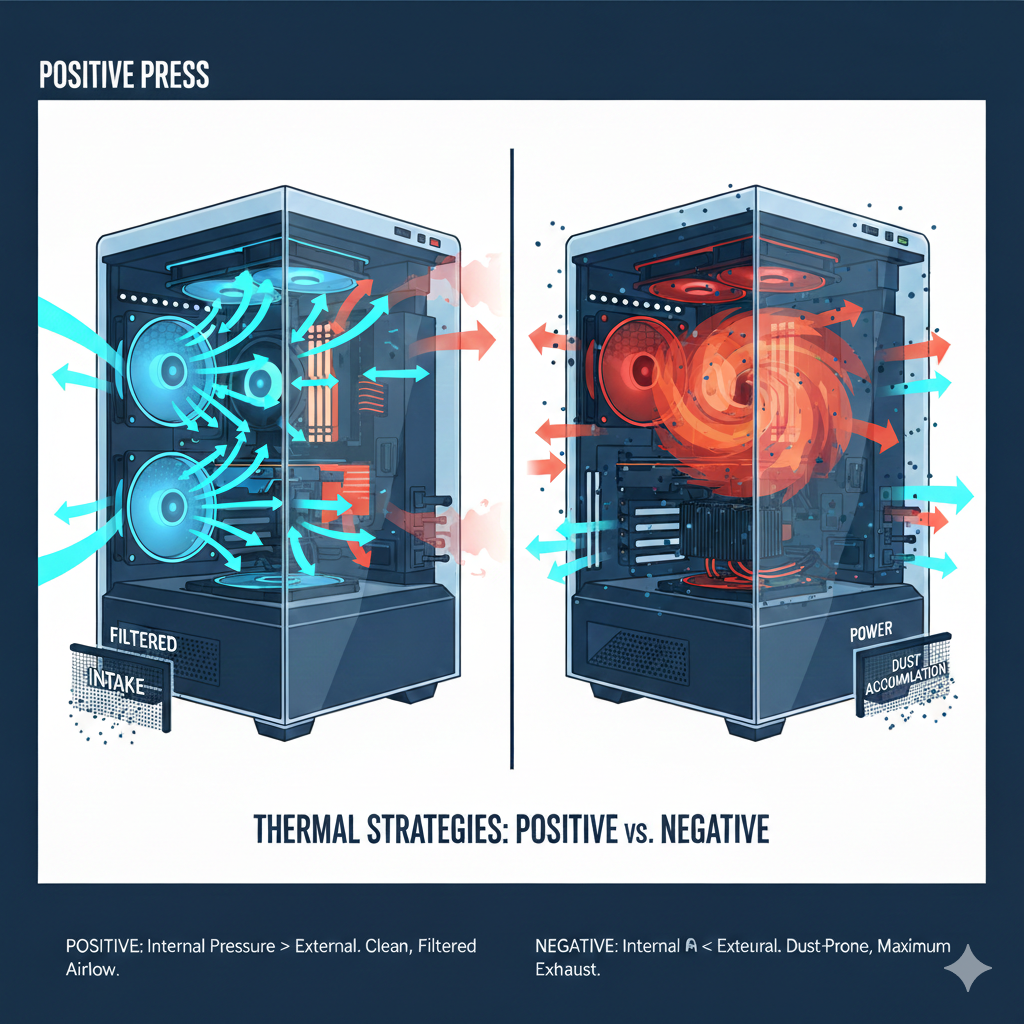
- Positive Airflow (Positive Pressure): Intake > Exhaust. Air is “pushed” into the device, creating higher internal pressure. Heat is actively forced out through ventilation gaps.
- Negative Airflow (Negative Pressure): Exhaust > Intake. Heat is “pulled” out of the device. External air is passively sucked in through every available crack and port to fill the vacuum.
⚖️ The Core Trade-off: Dust vs. Thermal Efficiency
As engineers or architects, we must weigh our options based on the specific application:
1. Cooling Efficiency: Negative Pressure Wins By aggressively extracting hot air, negative pressure effectively eliminates “dead zones” within the chassis. It is ideal for high-load, high-performance computing environments (e.g., high-end gaming rigs, rendering workstations). However, caution is needed: if intake is restricted, it can cause turbulent airflow.
2. Dust Control: The Absolute Dominance of Positive Pressure This is the “killer feature” of positive pressure. High internal pressure ensures air enters only through filtered intakes, and can even “blow away” dust from small gaps. For scenarios where frequent cleaning is impractical—such as NAS, home office equipment, or medical instruments—positive pressure is the top choice to reduce O&M (Operation & Maintenance) costs.
3. Noise & Structural Adaptability
- Negative Pressure: Extremely friendly to compact spaces (e.g., ITX cases, industrial PCs) because it isn’t picky about intake paths. The trade-off? High-speed exhaust can lead to increased wind noise and “whistling” through gaps.
- Positive Pressure: Requires meticulous airflow path planning. If the exhaust path is obstructed, “heat pockets” can form, negating the cooling benefits.
🎯 Precise Matching for Your Scenario
Choose 【Positive Pressure】 if:
- The environment is dusty (e.g., homes, non-cleanroom workshops).
- The device is unattended for long periods and requires low maintenance.
- Target Scenarios: Home NAS, laboratory precision instruments, HTPCs.
Choose 【Negative Pressure】 if:
- Performance is the priority; core components have high TDP (CPU/GPU at full load).
- Space is extremely limited, making structured ducting impossible.
- A regular maintenance/cleaning schedule is in place.
- Target Scenarios: High-performance server rooms, overclocking workstations.
💡 Conclusion
There is no “silver bullet” in thermal design. In modern industrial design, we often strive for “Slight Positive Pressure” or “Dynamic Equilibrium”—finding that sweet spot between cleanliness and thermal limits by precisely calculating the intake-to-exhaust ratio.
Professional thermal design is both a science and an art. With extensive expertise in fan R&D and thermal systems, ZND provides not only high-performance, high-reliability fan products but also tailored airflow design and optimization. We help your equipment find the perfect balance between efficiency, cleanliness, and silence.